
About 1810, James Callin brought his family west from Pennsylvania and established a farm in what is now Milton Township, Ashland County, Ohio. James and his brother, John, raised 15 children on that farm, most of whom were born in Pennsylvania before the families relocated.
Finding records of the Callin family’s arrival in Ohio have been fruitless, so far, but we do see both brothers listed in Milton Township on the 1820 Census, so we know they were there. We have so far taken the word of John’s grandson, George W. Callin, who claimed in his 1911 Callin Family History that James came to Ohio from Westmoreland County, Pennsylvania, in 1810, and that John followed with his family in 1816.
We also know from the history of the area that Ohio became a state in 1803. The Lewis and Clark Expedition began to survey the territory in 1803, which made it possible for the Federal Land Office system to sell that land to white settlers. Before that, the American army fought a campaign known as the Northwest Indian War, which culminated in the 1794 Battle of Fallen Timbers, near modern day Maumee. We have talked about how it is possible that the James and John Callin listed in the Kentucky Mounted Volunteer Cavalry present at that battle were the father and uncle of the James and John Callin who settled in Milton Township.
Breaking the Binary
Humans love binary thinking. This is why so much of the history you find is centered on conflict. The stories we repeat tend to reduce those conflicts to Us vs. Them, with clear lines and precise dates. We like heroes (Us) and villains (Them) and only enough nuance to drive a dramatic narrative in which the heroes win and the villains die or limp away to cry in obscurity.
Even when we try to break that pattern, to “correct” the narrative, we have a tendency to simply re-cast who the heroes and villains were, or add a third group that we can think of as “neutral” – which causes its own set of problems when you are trying to find out What Really Happened.
If the father of James and John Callin fought in the Northwest Indian War, his sons probably knew it. They almost certainly shared many of the same fears of the native populations that other European settlers carried – as shown in the stories passed down by two Callin families we talked about in Fear of the Foreigner. “Breaking the binary” means altering the formula of their story, allowing for more nuance than the traditional European view allows for.
Altering the formula does not mean changing the facts. The facts are that white settlers like James and John Callin were given an unprecedented opportunity for people of their class and status: to acquire land. That acquisition meant everything to them. Not just wealth, not just status that was unattainable in Ireland or rural England, and not just survival. A chance at controlling their own lives. And no matter who they saw as a threat to that chance, they were going to do whatever was necessary to take it.
They didn’t see themselves as “white settlers” or “European” at that time. They saw themselves as part of a bewildering kaleidoscope of culture, ethnicity, and religion. Scots-Irish Presbyterians like the Callins probably had a British identity thrust upon them, but even within the broad category of “British” you had a variety of competing groups of English, Welsh, Irish, and Scottish people who spoke their own languages and belonged to various Protestant groups or Catholic traditions (and possibly a few less official holdovers from centuries-old Celtic and Norse traditions). The “Dutch” among them would have included any number of people from early colonial Netherlands, as well as more recent German-speaking arrivals with their own religions and political allegiances. The U.S. version of North American history also tends to forget or minimize the presence of French and Spanish groups, especially those who lived outside of the British colonies.
To the Callin family, that crowd would have been reduced to “Us” in the coming generations of storytelling. So who was reduced to “Them”?
The Wyandotte Nation
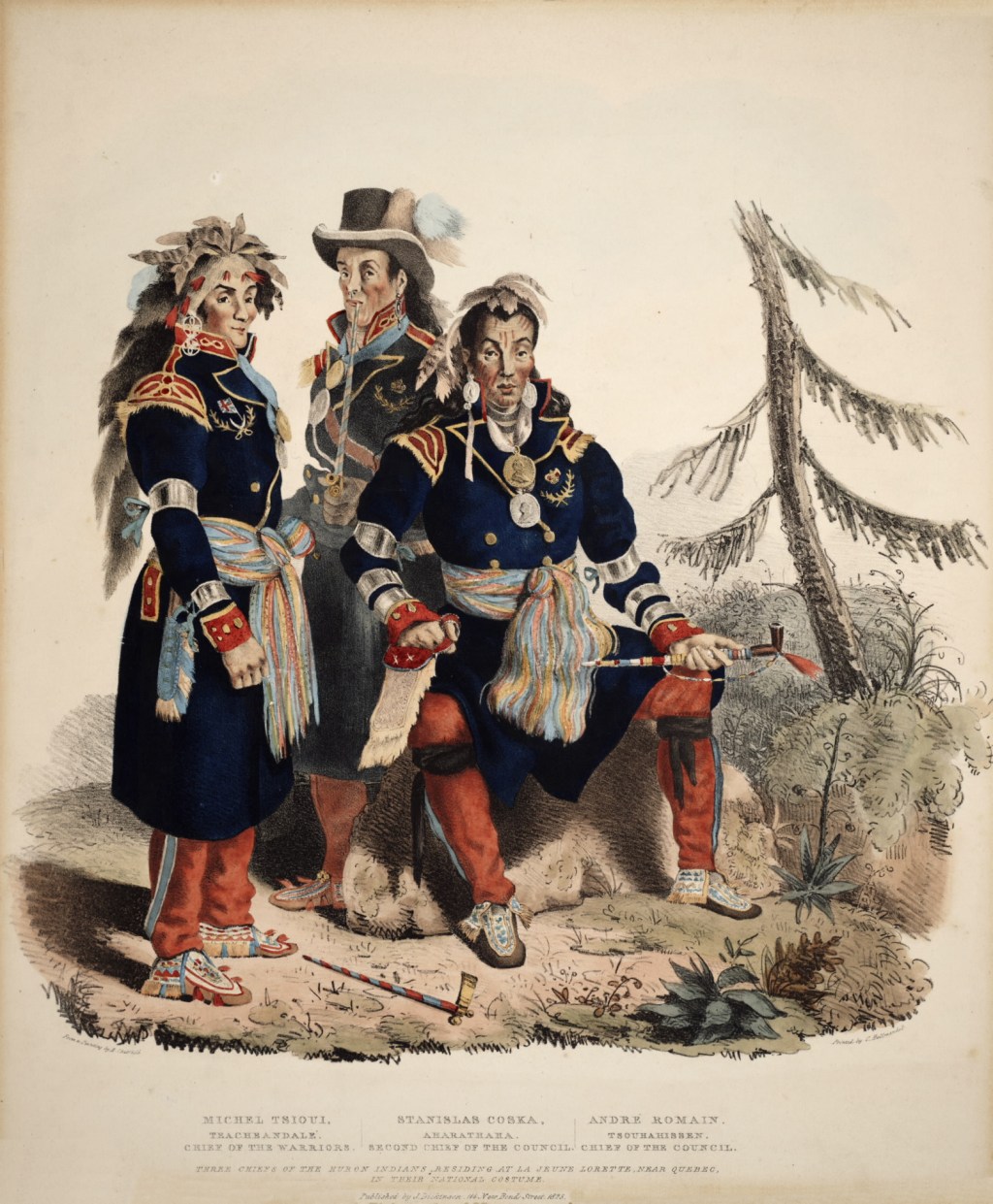
The Wyandotte Nation is a Native American Tribe of 7,150 tribal citizens, headquartered in Wyandotte, Oklahoma. According to their website,1 they are made up of “remnants of the Tionontati, Attignawantan and Wenrohronon (Wenro), all unique independent tribes, who united in 1649-50 after being defeated by the Iroquois Confederacy.”
The origins of these tribes can be traced back to an earlier Iroquois group known as the Wendat. By the 15th century, the precontact Wendat occupied the large area from the north shores of most of the present-day Lake Ontario, northward up to the southeastern shores of Georgian Bay. From this homeland, they encountered the French explorer Samuel de Champlain in 1615. They historically spoke the Wyandot language, a Northern Iroquoian language. They were believed to number more than 30,000 at the time of European contact in the 1610s to 1620s.
The Wendat were not a single nation, but a confederacy of several nations. The bewildering kaleidoscope of culture, ethnicity, and religion that described the encroaching European settlers certainly described the people who were already living on the continent. The Wyandot people who survived diseases and wars brought by the French, Dutch, and British colonists were displaced from Lake Ontario into the area south of the Great Lakes. They tended to ally themselves with the French, who called them the Huron. Their adversaries, the Haudenosaunee Confederacy (Five Nations, or Iroquois), tended to work against the Huron and allied themselves with the Dutch, and later, with the English who displaced the Dutch.
Disease cut the numbers of these Huron/Wyandot people in half, and their conflict with the Haudenosaunee drove them out in 1649, into the upper Lake Michigan region, where they settled at Green Bay, then at Michilimackinac. One hundred years later, after surviving numerous conflicts over trade with other indigenous nations and Europeans, the Huron-British Treaty of 1760 recognized the Huron (Wendat) as a distinct nation and guaranteed that the British would not interfere with the nation’s internal affairs.
And End to Centuries of Ongoing Conflict
Of course, the 1760 treaty wouldn’t end conflict in the area. A treaty with one European government was only good until that government ceded territory to another European government after one of the endless series of wars going on around the globe. After the British ceded the Northwest territory to the new American government, the Wyandot would join the Northwest Confederacy and spend nearly 10 years trying to prevent American settlement in their lands.
But after 1795, the Treaty of Greenville forced the Northwest Confederacy to cede southern and eastern Ohio and to recognize the U.S. rather than Britain as the ruling power in the Old Northwest. For the Wyandot people, this was the beginning of a 35 year period of struggle that would end when the U.S. forced them to relocate to Oklahoma.
For settlers like the Callin family, 1795 represented a watershed moment when the possibility of truly breaking free of the centuries of conflict in Europe and finding a place they could build their own lives on their own land became a tangible thing. If we choose to believe that James Callin fought in the Northwestern Indian War, we can also imagine that his motivation was to finally live free of the constraints of Europe’s overbearing conflicts over religion, feudal fealty, and constant conquest. I don’t say that to excuse the cruelty the new American government chose to inflict on the survivors of the defeated indigenous confederacies, but only to add the perspective that from James Callin’s point of view, he was just one individual taking advantage of a chance that few have ever had.
If that chance came at the expense of strangers he would never have to face, he probably found it easy to dehumanize them and ignore their suffering, allowing his God to take the blame or credit for whatever happened. And by 1830, when the Wyandotte nation was removed from Ohio to Oklahoma, his grandchildren had already begun to outgrow their new homeland and move further West.
Dispossessed vs. Diaspora
Humanity has learned a lot in the 200 years since the Callin family settled in the State of Ohio. And we still have a lot to learn. For example, I don’t really know for sure that any specific Wyandotte people spent much time on the land now known as Richland County, Ohio. They, or rivals groups, may have passed by or camped there. No one would have recorded that information. But I know they were in the general area, and I know what happened to them.
If I had the ability to go back and tell James Callin about the miracles and wonders that would come about within a few generations of his, I doubt I could change his mind about the wars he fought, or make him fear his indigenous neighbors less. Perhaps if he had been able to see that we would figure out how to fight off disease with sanitation and vaccines, or feed millions of people with industrial fertilizers, he might have been able to see the Wyandotte people as less of a threat.
I’d like to think that, armed with the knowledge I have, I would have done something differently in that time, but if I had lived then, I would not have had knowledge of what was to come. No one can see the future. We can barely see the present, and look how hard we have to work to see the past!
So I’ll keep doing my best to see my ancestors, and those they impacted, as whole people with entire cultures and histories that I can barely wrap my mind around. And I’ll do it for as long as I’m allowed to do so.
- I encourage you to visit https://wyandotte-nation.org/ and take some time to get to know the history and people who remain. ↩︎


Say hello, cousin!