
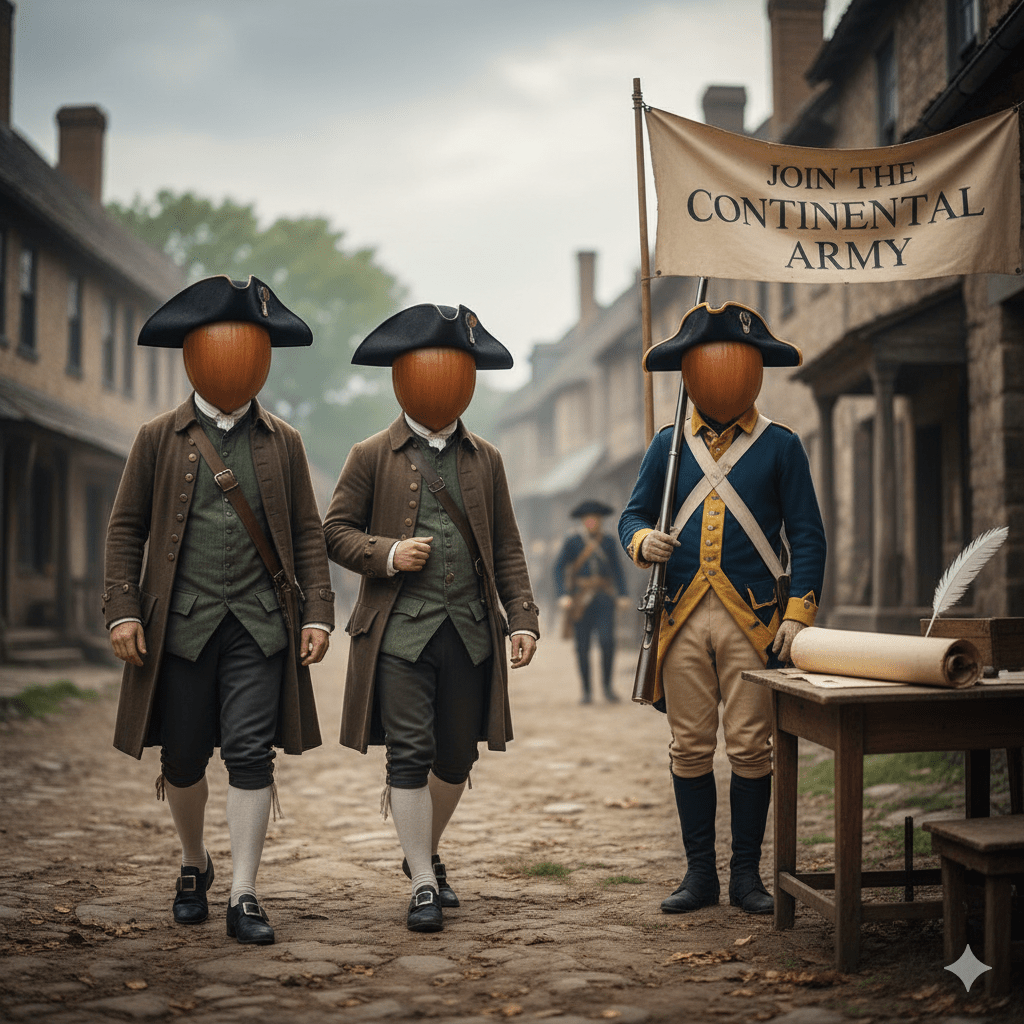
Note: this is a fictional representation based on my research (follow links and footnotes if you want to know more). To tell this story, I made assumptions about how these men might have thought and felt, and even about how the cousins might have been related. These assumptions are based on the available facts, but they might not prove to be true as further evidence comes to light.
James: September 1777
When Patrick, James, and Edward Callin met in Hanna’s Town that late summer morning in 1777, the cousins had different goals in mind.
They were young men in their twenties who lived in the surrounding Hempfield Township, but the eldest, Patrick, already had a family of small children, while young Jim and Edward had arrived from Ireland more recently and had not yet settled down with wives. Patrick intended only to bring home what he could find at market, but his cousins did not plan to return home that day at all.
The Callin men had come to town to make a commitment.
It had been two years since the Hanna’s Town Resolves were adopted on May 16, 1775, and since then, King George had sent military troops – both English regulars and German mercenaries – against his own people. Thomas Jefferson had written a Declaration of Independence that was adopted in Philadelphia and voiced some of the same complaints as the Hanna’s Town Resolves. Then New York had been occupied, and even the pacifist Quakers governing Pennsylvania realized they needed to authorize a militia.
“There is your recruiting officer,” Patrick said, pointing towards a man in a prominent corner of the square. His uniform stood out in the crowded market, and he had posted the Militia Act, passed in March of that year, on a board behind him.
“No,” said Jim, “I cannot bring myself to serve in an Army for the Friends. Cousin Edward has alerted me to another option.”
“What other option? You don’t mean to enlist with the Virginians, do you?” Patrick knew that as of 1776, Virginia had claimed the land of Westmoreland County, including Patrick’s own farm. Patrick himself felt torn between loyalty to his adopted country and his frustration with their government, but he hadn’t realized his cousins’ distaste for the way the Quakers and their German neighbors governed Pennsylvania ran so deep1.
Knowing where to placed one’s loyalty had become a difficult thing.
“Cousin, you know better than I do how our people have been used by these two-faced Friends!” Jim said. “They claim to want peace with French & Indian savages, then they put us out on land they aren’t willing to let us defend! You know well they regard us all the same as the Paxton Boys – but now that they feel caught between the frontier and the Crown, they deign to let us fight for them?”
He turned to scan the square, and spotted another man in uniform, standing with a group of young farmers and townsmen in a less well-trafficked corner. “If I must fight either way,” Jim said, “I will fight with real fighters.”
Leopold: August 1779
“He is at this time transporting large armies of foreign mercenaries to complete the works of death, desolation and tyranny,” Thomas Jefferson said of King George III in the Declaration of Independence.
As early as August 1775, when the news of the Battle at Bunker Hill reached the European continent, Prince Friedrich Wilhelm II of Hesse-Cassel offered his ranks of well-trained soldiers to the British king, knowing that Britain did not have enough troops to overtake the massive American colonies. At that time, Hesse-Cassel was one of seven principalities that made up what is now Germany.
Friedrich’s officers, coming from either the ranks of the aristocracy or the middle class, were well-educated, receiving advanced instruction at the Collegium Carolinium in Cassel, where they studied foreign languages, mathematics, and engineering. The men in the ranks were culled from the peasant class, frequently stolen off the streets by gangs of recruiters, and were segregated into units of Jägers (light infantry) or artillerists. The former group was made up of the sons of gameskeepers and foresters, and the latter tended to be the sons of industrial workers from the cities. At the bottom of the hierarchy were the “expendable people” (entbehrliche Leute): school dropouts, servants, unemployed tradesmen, or wandering homeless youths who were seized off the streets by recruiting gangs. All were indoctrinated with the German concept of Dienst, or sense of service, and swore a personal oath to Prince Friedrich2.
Twenty-one-year-old Leopold Zindle found himself stepping off a cramped English ship after several uncomfortable weeks at sea, wearing the uniform of a private in the Hesse-Kassel Erbprinz Regiment. Whatever he had experienced as a boy from Essingen, and however invisible or expendable he may have been on the streets of Germany, he now found himself provided with an impressive uniform, weapons, and freedom from having to think about what to do next.
“Do as you are told,” shouted the officer waiting for them to disembark, “and you will not be beaten. Fail, and you will run the gauntlet.” Leopold could see two lines of 150 soldiers each, facing each other, as another solider ran between them, stripped to the waist. He watched 300 soldiers, laughing as they beat the running man with whatever clubs or weapons they had on hand, and he resolved never to be so undisciplined as to receive such treatment.
With his attention on his duties at camp, keeping watch, and endless marching, Leopold did not have much time to devote to keeping track of where his unit was, or puzzling out what their strategy was. But he couldn’t help notice that the “American savages” they had been sent to subdue did not live up to the image of the dirty, drunken heathens described by their officers. Instead of finding rude huts and seedy fields, the regiment often marched past well-tended fields, and tidy towns full of well-built houses, many of which were occupied by people who spoke German!
Leopold’s fellow soldiers shared this opinion of the American populace, but took a dimmer view of the American soldiers. More experienced men described the poorly equipped and poorly drilled Continental soldiers they had seen during their time in Rhode Island and New York. Leopold’s sergeant frequently raised his canteen in mock salute to the Americans who had suffered through the famously brutal winter at Valley Forge, but had kept fighting throughout 1778 anyway.
“But of course,” he would say, “They owe it all to Von Steuben!” then spit on the ground.
On the morning of August 19th, 1779, while camped at the Fort at Paulus Hook in New Jersey, Leopold was awakened by shouting just before dawn. He and his fellow soldiers scrambled to dress and prepare their weapons, but in the early morning darkness, it was impossible to know friend from foe, let alone how many foes there were. By sunup, Leopold and 157 other prisoners were being led away by the 300 or so men under the command of Major “Light Horse” Harry Lee.
The prisoners were marched inland for several days, joining a larger body of the Continental Army long enough for General Washington to work out what to do with them. Leopold was among those sent to work for Jacob Faesch of Mount Hope, where barracks were built for 200 men. Their work produced cannonballs, which Faesch sold to the Continental Army. Faesch and many of the other towsnpeople Leopold encountered spoke German dialects, which made the coming years of manual labor in this foreign land easier to face.
For four years, Leopold was fed and sheltered in exchange for his labor, and he slowly learned about the people he was sent to subjugate for the British crown. Four years during which his homesickness would burn away in the coaling job and be replaced by something else.
Edward: New Year’s Day, 1781
Edward and Jim joined the 4th Virginia Regiment of Foot in 1777 a week after the Battle of Brandywine. A week after that, Philadelphia was captured by the British. It was a difficult time to be a new recruit, but they soon faced the British on the battlefield at the Battle of Germantown.
Their regiment was assigned to the 4th Virginia Brigade, commanded by Brigadier General Charles Scott. The young soldiers were impressed by General Scott. They learned from their new comrades how well their unit had been handled under General Sullivan’s Wing at Brandywine, where their actions bought time for Gen. Washington and the charismatic young Marquis de Lafayette to retreat without greater losses.
The first few months in the Army were grim, but at least they were together in the same regiment. They marched together into Valley Forge on 19 December 1777, and marched out again on 19 June 1778. Of the 12,000 men who established the camp, between 1,700 and 2,000 men died from outbreaks of typhoid, dysentery, influenza, pneumonia, and typhus, all made worse by the cold, wet weather and the inconsistent availability of food.
Those who survived that winter came out better trained, because Baron Friedrich von Steuben, a Prussian military officer, stepped in as drillmaster. He taught the soldiers how to use the bayonet, and most importantly, how to re-form lines quickly in the midst of battle. Sadly, a month before leaving camp, Edward was claimed by the 6th Pennsylvania Regiment, and would no longer be so close to Jim.
Their first major engagement after leaving Valley Forge was fought near the Monmouth Court House in modern day Freehold Borough, New Jersey. Jim and Edward were both once again technically under command of Gen. Charles Scott. Jim and the 4th Virginia were led by Col. William Grayson after Maj. Gen. Charles Lee shuffled his troops before the battle began. Edward was under command of Lt. Col. Josiah Harmar in Scott’s detachment in the forward screen. The results of the battle were inconclusive, but the majority of losses on both sides were due to heat-related illness and the Continental Army retained possession of the battlefield. For the first time, Edward thought, victory seemed within reach.
Now that they were in different units, it was harder for Edward to keep track of Jim. He got word that Jim was sick during July and August, recovering at Camp White Plains. He also heard when Jim took furlough that winter and went home to marry.
In June of 1779, Edward’s unit was deployed under Maj. Gen. Sullivan on his expedition to respond to attacks on American settlements made by Haudenosaunee (Iroquois) and Loyalists during the previous year. The Haudenosaunee had supported the British during the 1777 Battles of Saratoga, as well, and Sullivan’s army carried out a scorched-earth campaign that destroyed 40 villages throughout the Finger Lakes region of western New York. The campaign drove just over 5,000 Haudenosaunee to Fort Niagara seeking British protection, where many of them starved and froze the following winter, as the British were unable to supply them. This had the desired effect of stopping the attacks. It also depopulated the area for post-war settlement.
Edward’s regiment spent the rest of the year in garrison at West Point and probably wintered at Morristown. Jim had returned from furlough and camped with his unit near Morristown in November 1779. The next year, Edward’s regiment took part in a number of small engagements in New Jersey and again wintered at Morristown; but Jim was supposed to have been sent to serve with General Scott again. Edward knew the Virginians had marched nearly 800 miles from Morristown to Charleston, South Carolina, only for Continental General Benjamin Lincoln to surrender, but he didn’t know if his cousin had marched with them. As far as he knew, Jim was being held prisoner.
By this point, at the end of 1780, Edward was tired. He had served his three-year enlistment as of September, but the end of the war was nowhere in sight, harsh conditions persisted, and the army had not released him. On 1 January 1781, 1,500 soldiers from the Pennsylvania Line, the 11 regiments under General Anthony Wayne’s command, protested that their three-year enlistments had expired and complained that they had not been paid.
For a week, the mutiny could have ended violently, but General Anthony Wayne and Congressional President Joseph Reed knew that how they treated these men now – men who had served more than a full enlistment already – would affect their ability to recruit. Since the men brought complaints that officers had tricked or punished soldiers to extend their enlistments, Reed concluded it would be better to meet their demands.
Edward took a $20 bounty, and clothing, and went home.
Apres la Guerre
To simply say that “war changes men” is not enough. How it changes them depends on their character, and on the things that circumstances force them to endure.
Jim Callen had a difficult enough time abiding by the authority of the Pennsylvania Quakers before he went to war and he came home with an even deeper mistrust of government. He never talked to his family about what happened to him when the Virginian regiments marched South, but he complained bitterly and often about the “decisions by committee” in Congress that kept Washington from acquiring needed supplies. He wouldn’t speak at all of his experiences after the surrender at Charleston, except to say that General Scott had been betrayed, and all Virginians with him. He would follow Gen. Scott again, fighting with the Kentucky Mounted Volunteers at the Battle of Fallen Timbers near what is now Toledo, Ohio, in 1794.
Edward also had trouble talking about his experiences. While the expedition against the Haudenonsaunee had been framed as justice in response to their attacks, the sight of highly trained soldiers razing a village full of freezing and starving families never sat well in his heart. When he married and looked for land to raise his own family, he wouldn’t consider the towns in the Finger Lakes region.
Leopold’s change was probably the most dramatic. He began his journey as an aggressor, seeing himself as the civilized warrior sent to bring order to a wilderness. Four years working for Mr. Faesch had convinced him that there was already a new kind of order in this New World, and he wanted to stay there to build his life. Despite the attempts of three armies – German, British, and American – to compel his allegiance during those four years of war, he decided to stay in Morris County as his own man. An American man.
Jim and Edward never met Leopold, despite spending the New Jersey winter of 1778 within 17 miles of each other. Who knows how many of Leopold’s cannonballs the other two men saw fired on the British. Who knows how many of Jim’s and Edward’s defensive engagements kept the British from putting a torch to Leopold’s barracks. After the war, they would never know that they made each other’s lives possible.
Just as they could never know that the great-great-granddaughter of Leopold’s great-great-grandson would marry the great-great-grandson of Jim’s great-great-grandson – or that a great-great grandchild of that marriage would write this story in 250 years.
This story is part of the celebration of America’s 250th birthday at Projectkin – Stories250.
- JSTOR: Journal of the Presbyterian Historical Society (1901-1930), Vol. 3, No. 5 (MARCH, 1906) pp. 201-252 ↩︎
- Salamida, Joseph C. “The Hessians Are Coming!” Warfare History, April 2007 ↩︎

 Mightier Acorns
Say hello, cousin!