
Among the other disruptions in October, Microsoft alerted me that my computer’s operating system would no longer be supported. Rather than try to upgrade to Windows 11 (not really an option for a system as old as mine) or buy a new PC during America’s economic collapse and government shutdown, I decided to install an Ubuntu operating system.
Long story short, I am now using “Noble Numbat” after several days of transferring/backing up files and trial and error. (What is a “numbat” you ask?)

In addition to unearthing some files I had forgotten about (which I am already drafting into future posts!) the installation process required me to sit and wait for things to happen, which got me thinking about how some of the technological changes in our recent history have changed the way we live.
The Humble Inventor
My great grandaunt, Emma Beatrice Callin, married George Delorain Matcham in 1907 in Fostoria, Hancock County, Ohio. George was the kind of person you might picture when you read about America’s Progressive Era.
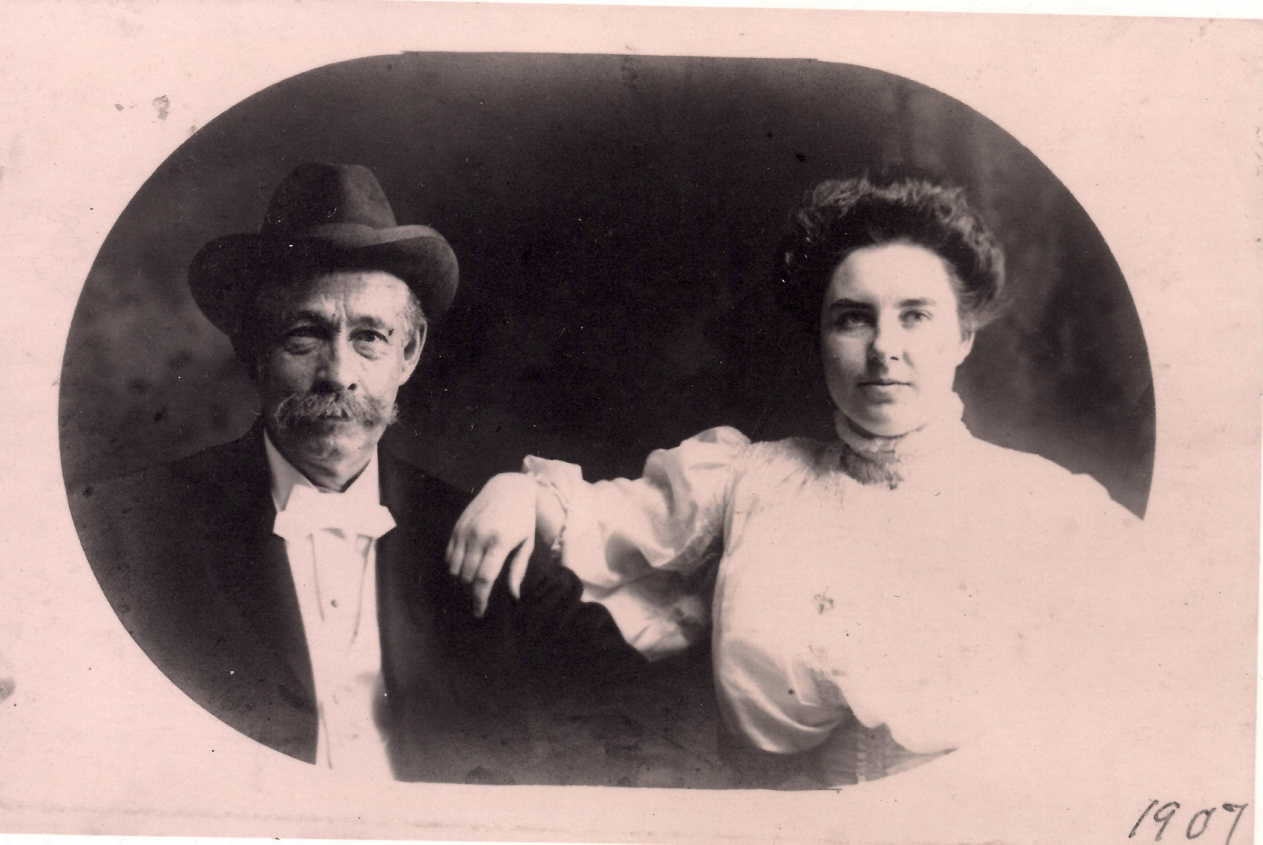
George was not a healthy boy, suffering from unspecified conditions that kept him from making a living in more physically demanding professions, and forcing him to delay his studies at Oberlin College. But after completing his business studies, he took out several patents on farm equipment, which provided him and his first wife, Marion, with an income and the means to invest in the resort they developed later in Linwood Park, on Lake Erie.
Just for fun, if you have any ancestors who were inventors, you can look up their patents on the U.S. Patents and Trademark Office website. I found George by looking for “Matcham” in the “Everything” field:
- US-0068449-A – 1867-09-03; a sheep stock
- US-0234834-A – 1880-11-23; a road scraper
- US-RE09870-E – 1881-09-13; an improvement on his 1880 road scraper
From Farm to Railroad
When Emma’s great-grandfather, John Callin, died of tuberculosis in 1835, his probate documents included “A true and accurate inventory of the goods & chattels of the Estate of John Callen” that was appraised at a value of $231.50. That amount in 1835 is equivalent in purchasing power to about $8,522.78 today.
That inventory doesn’t have a lot of things listed; if you leave off the livestock, there are a few key pieces of farm equipment, like the “patent plough Double & Single Trees” ($2), an “Iron pinned Harrow” ($4), and a wagon ($40, now a $1,478 value). At the top of the list, you can see John’s $12 “Rifle Gun,” which is the rough equivalent of $442 today – about the same price as a low-end rifle in 2025. (If only you could still get a car for under $1500!)

That generation that included George and Emma saw several historical trends in the development that would have astounded a man like John Callin. John’s entire world was built around working the land with his sturdy, but simple, tools. Feeding his family, selling crops and his labor; those were his priorities. The innovations that went into building the railroads and improving crop yields using less human labor transformed the United States from an agricultural backwater into an industrial powerhouse, capable of not only feeding the world, but transporting its goods globally.
But the world that George and Emma faced was one in which the population of the world was outgrowing the ability of even the most productive farmers to feed it.
A German scientist named Fritz Haber changed all of that when he developed a process for making nitrogen-based fertilizer. Of course, Haber’s story is complicated; he’s the same scientist who created the gas used to exterminate people in the Nazi concentration camps in World War II. And the innovation that allowed farmers to increase their production so dramatically also cost them something that modern Americans still pretend we have.
How We Innovated Away Our Independence
John Callin’s son, William, was known as a physically strong man who cleared more than 160 acres of land to establish the farms where he raised his family. He was the sort of man that later generations thought of as a “rugged individualist,” even though he depended heavily on his neighbors and his community for his survival; especially when he was later afflicted with “rheumatism,” the reward for all of his hard, physical labor.
One of his descendants described him by saying he “was an industrious, hardy, persevering man, possessing great physical strength, but had only a limited knowledge of books. He had a mind of keen perception and sound judgment, and was well fitted for pioneer life.” But William wanted something better for his sons. He knew better than most how hard it was to make a life the way he had, and he probably knew that the American model of raising large families on a few hundred acres of farmland was not sustainable. He made sure his children were educated, so that they could thrive in the world of business and industry that was growing around them.
His son, John Henry Callin, became a teacher, and after surviving the Civil War, he became a businessman and local leader. He did not work a farm, and neither did any of his children. His sons followed his example, working as teachers and professors, investing in property and building houses, or working on the railroads.
Like so many other Americans who left farm life behind to find work in cities, they made a trade. They increasingly depended on others for their food and sustenance. Growing your own food has always been hard, time-consuming work, and after World War I, Fritz Haber’s marvelous fertilizer innovation made it easier for those who still farmed to support those who didn’t.
And since then, we have all lived with the trend of small, independent farmers being bought up by international corporations – Cargill, Archer Daniels Midland (ADM), Bunge, BASF, and Wilmar International, just to name a handful. The average American has no idea how they might feed themselves without products from these companies arriving at their local grocers.
What Would They Think Of Us?
As I wrote last year in The Meaning of Work:
I doubt that my 3x-great grandfather, William Callin, who cleared acres and acres of Ohio forest with his five sons and turned his land into prosperous farms, would recognize anything I do as “work.” He probably would have been appalled that his grandchildren were leaving the farms he worked so hard to establish so they could earn wages in factories. Industrialization was, to men like William, something to be resisted, and they made compelling moral arguments against it. In 1869, The New York Times described the system of wage labor as “a system of slavery as absolute if not as degrading as that which lately prevailed at the South”.
If you look at things from William’s point of view, or at least from the point of view of Midwestern American Protestants like him, the only thing more morally outrageous than not working would be to have someone else steal your labor. This would explain why people like William and his brother George were willing to defy the law and help enslaved people escape from the South.
You may notice the contradiction there – that William wanted something better for his sons, and would have been appalled by the way the industrialized world steals labor and exploits every resource in the pursuit of maximizing sharehold benefit.
We all live with that contradiction today. Our current disruptions are driven by it. People may not think deeply about the roots of their problems, but they instinctively know that they are being ripped off. They blame all the wrong people for it, of course. They allow themselves to buy into any number of false binaries to explain the trap we are all in, boiling everything down to battles between “civilizations,” races, cultures – everything but the actual conflict that has always plagued humans.
Who holds the power over everyone else?
Our technologies are at a point where we could feed everyone, house everyone, and focus on curing more of the diseases that threaten everyone. But we allow those who control our access to food, housing, water, and health care to tell us that our neighbor is a drain on resources. We let them use our fear of each other to cheat us out of our future.
Americans, especially those who consider themselves to be “white,” carry a lot of fear inherited from previous generations – fear of the Native people we displaced, fear of the people we enslaved, fear of the immigrants we needed for labor, fear of those who believe differently. That fear works both ways; the surviving Native people have a reasonable fear of exploitation, the descendants of enslaved people have suffered through hundreds of years of being “othered,” and anyone coming here to find a better life lives under constant fear that they will be rejected.
The question you have to ask is this: do we have to continue to accept those fears? Or can we look past our fear and find a way to take advantage of those technologies that promise to make our lives better? Can we stop blaming our neighbors for being as dependent on our corporate masters as we are, and turn our attention to convincing those corporate masters that they are better off continuing to feed all of us? They have the means to do so.
Without all of us out here to consume their products, they don’t have any of their wealth or power. And they tell us every day that’s what they fear.
And that’s why they keep developing newer, more disruptive technology.
 Mightier Acorns
Say hello, cousin!