
In previous posts (see “Religion“) I have touched on ways that you can use what you know about your ancestors’ religion to learn more about them.
Knowing what specific faith group they ascribed to can tell you a lot. Sometimes you can learn about them from detailed church records, like the Quakers in the U.S. or extensive Roman Catholic church documents in Ireland. Sometimes, what you learn about their church affiliation can explain choices they made, such as their position on abolition or making risky cross-country trips to start a new life.
Studying your ancestor’s faith traditions will never be a straightforward process. Simply applying a religious label to a person is never enough to understand or explain who they were. We all contain multitudes – and no group of people is a seamless monolith.
Quakers (for one example) were known as pacifists, but examples of Quakers enlisting in the U.S. military go back to the Civil War1. That kind of apparent contradiction is an opportunity to dive a little deeper into what makes a person a Quaker, and illuminate how your ancestor related to their time and place.
But that deeper dive will require you to ask difficult questions. These questions will be difficult both in the sense that the answers may be buried in dense, academic language, and in the sense that you may find yourself having to confront dearly held beliefs in a way that makes you uncomfortable.
Take a breath – and take notes on what you need to study later.
The Founding Myth: “They Came for Religious Freedom”
Like most American kids in the Cold War era, my grade school history classes breezed through the arrival of Europeans on the North American continent and simply described the Pilgrims and the Puritans as people who fled Europe because they were being persecuted for their beliefs. While this summary is not quite “false,” it fails to convey how violent everyday life could be throughout pre-colonial Europe, and it reduces all of the differences between people to a false binary. It also oversimplifies how that violence was driven by the corrupting power struggles between Churches and what we now call States or even Corporations, spanning a period of more than 1,000 years.
That way of telling the history also fails to admit that those fleeing persecution immediately began persecuting everybody else as soon as they had the power to do so:
The religious persecution that drove settlers from Europe to the British North American colonies sprang from the conviction, held by Protestants and Catholics alike, that uniformity of religion must exist in any given society. This conviction rested on the belief that there was one true religion and that it was the duty of the civil authorities to impose it, forcibly if necessary, in the interest of saving the souls of all citizens. Nonconformists could expect no mercy and might be executed as heretics. The dominance of the concept, denounced by Roger Williams as “inforced uniformity of religion,” meant majority religious groups who controlled political power punished dissenters in their midst. In some areas Catholics persecuted Protestants, in others Protestants persecuted Catholics, and in still others Catholics and Protestants persecuted wayward coreligionists. Although England renounced religious persecution in 1689, it persisted on the European continent. Religious persecution, as observers in every century have commented, is often bloody and implacable and is remembered and resented for generations.
“Religion and the Founding of the American Republic; America as a Religious Refuge: The Seventeenth Century, Part 1″ (Library of Congress website)
The way we were taught our history allowed us to believe that the religious persecution in Europe magically ended when those persecuted groups arrived in the colonies, allowing students to assume that since modern America has “religious freedom” and “separation of church and state,” those were concepts that existed here already. But, in fact, the Puritans who established the Massachusetts Bay Colony treated their neighbors just like their oppressors in Europe had treated them, due to their “conviction…that there was one true religion and that it was the duty of the civil authorities to impose it, forcibly if necessary.”
It took European colonists nearly 300 years (from arrivals in the 1500s until the ratification of the U.S. Constitution in 1789) to establish a country where the law of the land assumes that people with differing faiths can live in the same town without murdering each other. To this day, it is considered impolite to discuss Religion or Politics, not because “you might offend someone,” but because a lot of people still struggle with the notion that their personal beliefs should not be “inforced” on everyone.
The downside of not talking about Religion, of course, is that few people are capable of thinking rationally about religious concepts. Like these:
All Schisms Great or Small
Do you believe that individual people have free will?
If you are an American, I predict that you will answer “Yes” without thinking about it2. But in certain parts of Europe during the Protestant Reformation, Calvinists taught a strict notion of predestination that ruled out free will; and disagreeing with their position could get you arrested, prosecuted, and in some (admittedly rare) cases, killed for your heresy. Today in America, Calvinist denominations like Presbyterian and Reformed churches still exist, though I wonder how much emphasis they place on this concept, or how divisive it is.
The point is that these sorts of schisms in Christianity are as old as Christianity. Some of the earliest divisions were stark, revolving around the question of Jesus was human or divine or something in between. Since I was raised as an evangelical Christian and never met another Christian who thought this, I was surprised to learn that “53% of folks professing Christianity and 43% of evangelical Christians agree with the statement, ‘Jesus was a great teacher, but he was not God.’”3
One of the most influential schisms was between the original view of Peter and the Apostles that Jesus was the Jewish Messiah and the view of Paul that led to the development of the Christian church separate from Judaism. If you are familiar with Christian history, you should be aware of the Council of Nicaea in 325 A.D. in which (among other things) decisions were made about which books would be included in the Bible and which would not. If you read up on the various schisms from the first 300 years of church history, then read the statement of faith known as the Nicene Creed, you might see how the Council attempted to bridge differences that seemed at the time to be unbridgeable. And if you study the Protestant Reformation that took place more than a thousand years later, you might recognize some of the same arguments cropping up again with some new twists.
The Great Awakenings
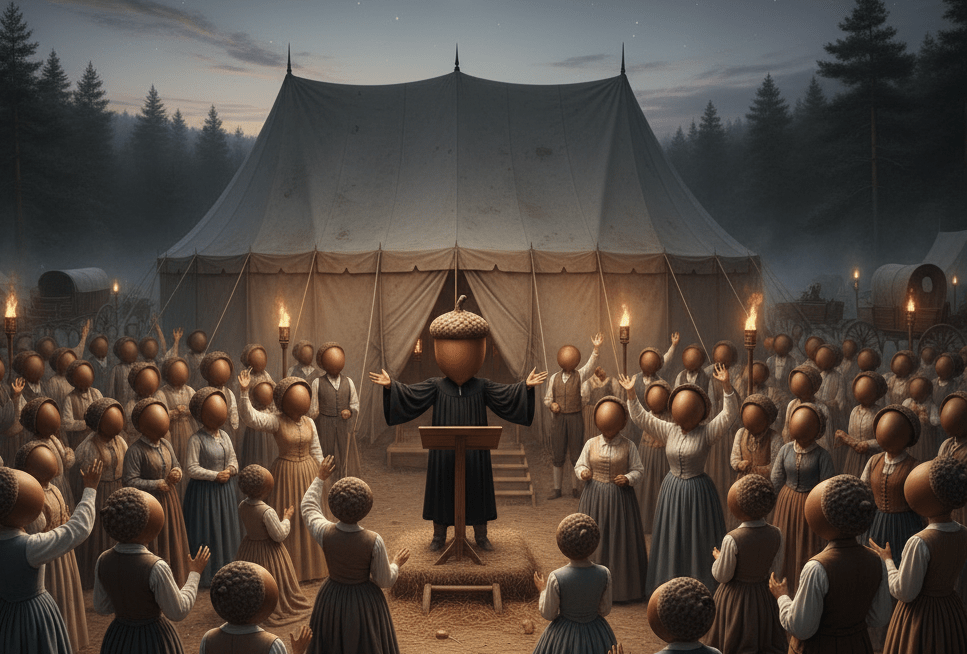
Understanding at least the general background of all that history is necessary to understand the periods in American history referred to as “The Great Awakenings” – which is where most Americans will find ancestors intersecting with religious history.
Many of you will be able to trace your own religious heritage through at least one line of your ancestry. I was raised in the Southern Baptist church, both of my grandfathers were ordained Southern Baptist ministers. The Southern Baptist Convention was founded in 1845, so it wasn’t really a choice for the generations before the Civil War. On my paternal grandfather’s side, folks seem to have favored either the Methodist churches or one of the non-denominational groups, usually (confusingly) referred to by names like “the Christian Church,” “the Church of Christ,” or “Disciples of Christ.” My paternal grandmother’s people were descended from “Pennsylvania Dutch” groups, consisting mostly of Lutherans or German branches of different Protestant groups. And, of course, I’ve written before about our Quakers.
However far up you may trace your religious roots, as you work your way back “down” your tree, you may find cousins belonging to newer, increasingly more diverse, faith groups that grew out of those Great Awakening periods, especially those founded in the 1840s. In each case, you will need to learn what drove those different groups to form or to split from older churches. Did they differ over ideas like adult baptism vs. infant baptism? Did they follow a strict orthodoxy guided by clergy or did they base their faith in their conscience and a direct, personal relationship with God?
This is where your personal beliefs may create a bias that makes it harder for you to understand the beliefs of your ancestors. Perhaps your grandparents converted from an older faith, and passed down acrimonious notions about that older faith to you. Will you be able to look past “that group is wrong and bad because they teach X” and understand your great-grandparents were really like?
And how deeply did they “believe” in the things you associate with their church? (Were they strict or lax about “rules” like swearing, dancing, drinking, etc.?) Were their political beliefs driven by their religion, or the other way around?
Everything Is Relative
In genealogy, you often have to decide “what is true” without having solid evidence. We do the best we can, and some evidence (like courthouse records or personal letters) are as solid as we can get. Even with the best records, we know that clerks can make mistakes and not every event gets recorded4. And personal letters might be unreliable, depending on context; one unreliable narrator can foil a whole theory.
Once we arrive at a conclusion, we like to assume that we can rely on that conclusion, and often reject new evidence that casts doubt. Especially if the work to gather and analyze that evidence was hard to do. Religion is often about placing faith in a “firm foundation” – believing things without evidence, and rejecting ideas that challenge that foundation. Combining the two disciplines can create a conflict between evidence and belief.
But if you want to be sure your foundation is solid, you have to be willing to re-examine it, test it, look for cracks, and be willing to repair it.
- Schmidt, Mark A.; West Chester University, Digital Commons; “Patriotism and Paradox: Quaker Military Service in the American Civil War“, HIS 480 (submitted April 18, 2004); Web adaptation copyright 2004 by Jim Jones. ↩︎
- Yes, I am aware that most people aren’t aware of the differences between “choice,” “agency,” and deterministic philosophies. This is a broad assertion meant to make a point, not an academic dissertation. ↩︎
- Cory Allen Heidelberger, “Majority of Christians Think Jesus Was Just a Good Teacher, Not Divine,” Dakota Free Press, 14 December 2022. ↩︎
- Not to mention studies that indicate about 5% of the population may discover a “non-paternity event” (unexpected parent) after DNA testing. ↩︎
 Mightier Acorns
Say hello, cousin!