
A few years ago, my Aunt Vicki entrusted me with a priceless artifact: a water and heat-damaged notebook full of poems written by our ancestor, John H. Callin (1840-1913).
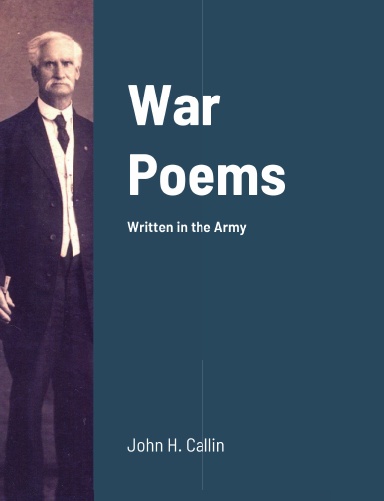
Transcribing the handwritten poems became my COVID project in 2020, and if you have ever worked with handwritten materials, you know it was no easy task. I am proud of the finished product, which you can find for sale on Lulu.com:
The Making Of…
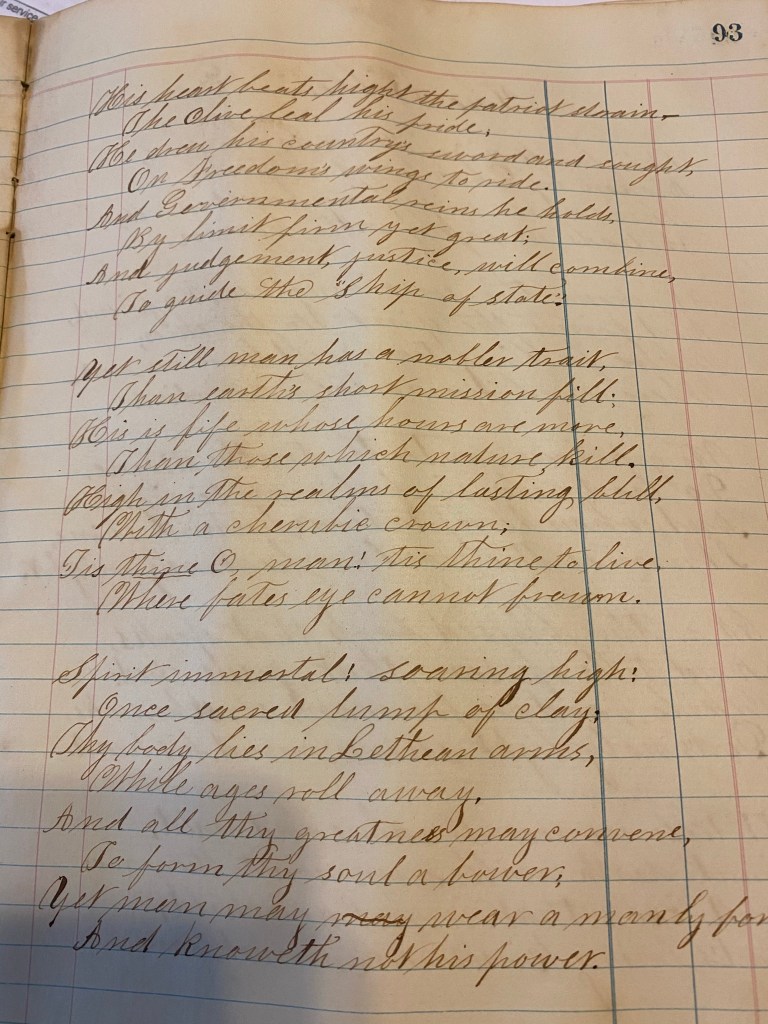
Here’s a sample of what I had to work with. At first, Vicki sent me images like these, rather than risking the loss or further damage to the book from sending it through the mail. But this proved to be unworkable, if only because I kept having to pester her with questions about specific words or lines.



With some research in the Library of Congress archives, I was able to illustrate a few of the poems with public domain images. My goal was to make all of the poems legible and understandable to a modern audience, so there are a few endnotes to explain some of the background experiences that informed John’s poems.
This poem was most likely written after he and his men of the 21st Independent Battery of the Ohio Light Artillery were dispatched to head off General Morgan’s army. The 21st was deployed to Camp Dennison, Ohio, at the end of May 1863, and they put up a solid resistance in July when the Confederates attempted to capture the area. Morgan and his troops entered Ohio on 13 July, and battled their way north. Eventually, Morgan was flanked and cut off by Union forces on July 26, 1863 at the Battle of Salineville, near Lisbon, Ohio. At 2:00 p.m., they surrendered to Union Maj. George W. Rue of the 9th Kentucky Cavalry near West Point, Ohio, approximately 8 miles northeast of Salineville.
John’s war record suggests that he was personally involved in pursuing and stopping Morgan, and he wrote about it with some passion:
The Morgan Raid
When Morgan plunged across our lines,
There to enact his dark designs,
He roused the northern patriot minds,
To a state of desperation.He knew his blade—that wily chief,
And plunged the peaceful heart of grief,
Then hastened off, his stay was brief,
To his sword of depredation.He saw the vistige of his clan,
And heard of deeds of that bold van,
Which fired the heart of Northern man,
To restrain this bold invader.Who strewed the ground with burning red,
And numbered many with the dead,
Then on into Ohio sped
The vile and intrepid raider.Ah, here he met the Union brave,
Numerous as Pacific waves,
Awaiting only to make graves,
For the Morgan devastators.The Union breasts were filled with ire,
And Federal hearts were now on fire,
And wilder than Secession’s pyre,
Burned the hate of raid creation.Then in pursuit our braves were sent,
Who proudly on their mission went
To capture were their soul’s intent,
And feed them on our rounders.We pressed them hard o’er field and stream
While oft the unsheathed sabre gleams,
As over hills our weary teams,
Dragged the heavy bronze Twelve Pounders.And on Ohio’s looming banks,
Surrounded by the Federal ranks,
Ended were all the raiders pranks,
By Union braves and musketry.When our malignant cannons roar’d,
Morgan resigned his rebel sword,
And many traitors there were lowered
By our fatal artillery.And now within States Prison shades,
Thou there can think of all thy raids,
From private to guerilla grades,
Thou chief of blood and misery.
Other Highlights
Artistically, these poems follow some strict rhythmic and rhyming structures that might not appeal to a modern audience, but which sound to me like the kind of poetry a young John H. Callin might have been surrounded by in his semi-rural Protestant community. They often feel like they are informed by the hymns he sang in church or the sorts of romantic poetry that might have been translated from French and German and imitated by American poets.
Whatever you may think of his skill as a poet, the subjects he chose and how he felt about them give us a deep insight into the mind of a Union soldier, both on the battlefield and in the years after.
John wrote poems about his experiences, like The Morgan Raid, but also about popular figures (like Generals Grant and Lee) and events that weighed heavy on the minds of Union soldiers. John wrote about several events that he wasn’t present for, but which were certainly the subject of stories around the campfire:
- The Execution of Private William H. Johnson in December 1861
- The death of Elmer Ellsworth
- The Assault on Ft. Wagner, South Carolina (the same battle featured in the 1989 film Glory, and the second battle where his brother, James M. Callin, was injured)
- The sinking of the CSS Alabama during the Battle of Cherbourg
John also wrote about love and his longing for someone back home – someone who was probably not my great-great-grandmother, Amanda (Walker) Callin! John married Lucy A Patterson after the war, on 27 Oct 1865. It is unclear whether she is any relation to the Captain James W. Patterson who commanded John’s unit during the war. If she is the daughter of Martin Patterson (1818–1891) and Abigail Osgood (1820–1908), then she appeared in her parents’ home under her maiden name in 1870. (John’s whereabouts in the 1870 Census are not known.) John and Lucy divorced in 1873 in Bowling Green, Wood County, Ohio, according to John’s pension record in the National Archives, with the note that there were no children from this marriage.
If any of this sounds interesting to you, it might be worth picking up a copy of War Poems to commemorate your own Union soldiers – and maybe consider donating a copy to your local library?
I’m sure John would approve of that.


Say hello, cousin!