
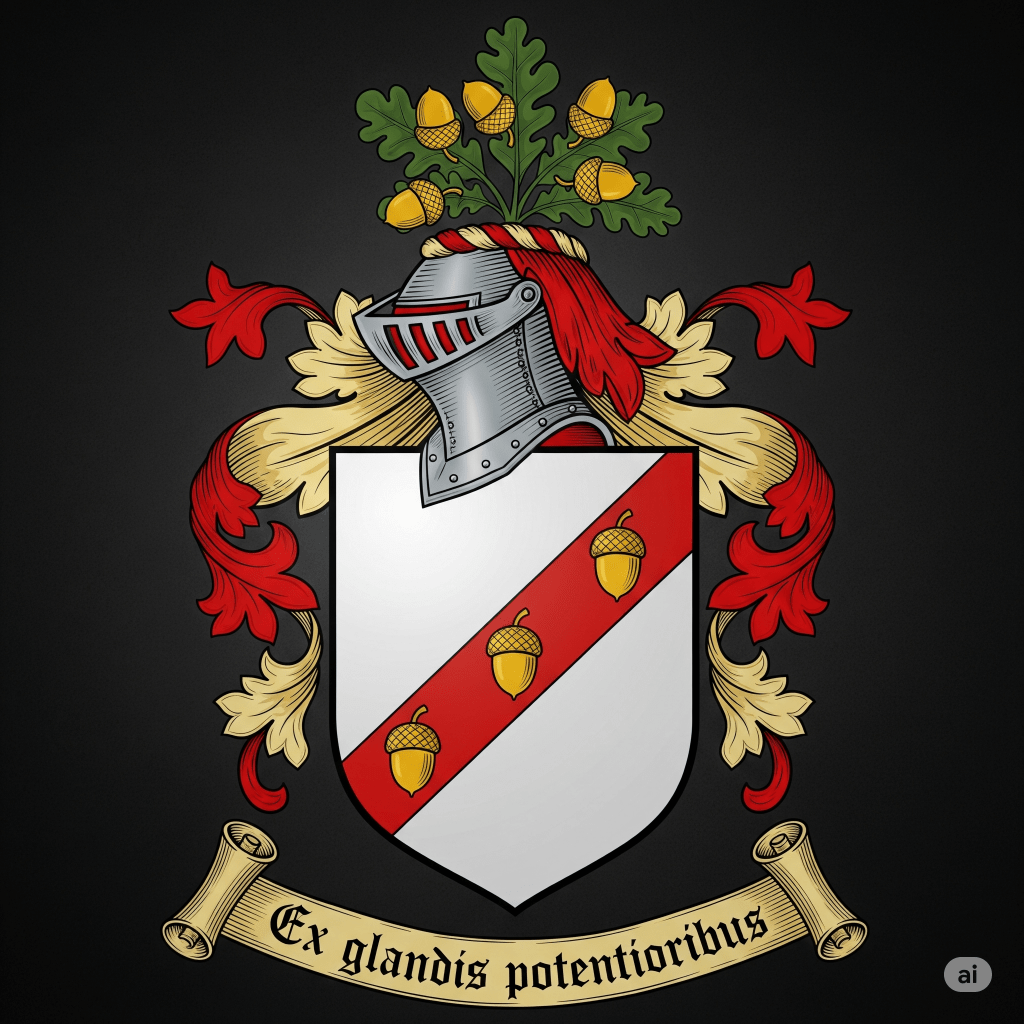
My 4th cousin, 3x removed, Robert Lewis Hale (1895-1977), was a fellow genealogist. He died when I was five years old, and he left behind a body of research similar to The Callin Family History. His book was privately printed after his death, probably by his daughter, Hester Ann Hale (1927-2008). “H.A. Hale” donated copies to at least a few genealogical societies, and I was able to find four physical copies held in four libraries on WorldCat.
Secondary Source Conundrum: Is It Trustworthy?
Finding a book like A History of the Family of Hugh and Mary Hales isn’t the end of my search for my Hale/Hales ancestors, but it is still an exciting landmark for me.
The preface tells you a bit about the quality of the research that went into the book.
“Many years ago I was furnished a copy of data contained in an old family Bible that belonged to my great great grand-father, Hugh Hales, Jr. About a dozen years ago /written in 1965, I decided to try to see if I could compile a list of all the descendants of this family.”
That is Robert L. Hale’s own explanation of the purpose of this book. What follows is a copy of the family history аs he had compiled it (with minor additions and corrections) up to the time of his death, September 13, 1977.
It represents many years of part-time research and, while it obviously is incomplete, it should be accurate for the most part – at least to the extent that public records and recollections of family members are accurate.
Most of the information has derived from Census, court house, and cemetery data. Much was furnished by members of various Hale branches and from people acquainted with them.
Because Mr. Hale enjoyed his hobby and appreciated the help he had received, it was his wish to share his findings with other family historians.
Unfortunately, in the interest of presenting a concise Descendants Report for our progenitor, Hugh Hales (1737-1817), Mr. Hale left out specific citations for much of the research he did. There are places where he mentions whether a fact came from the Hales family Bible or from another family Bible, and he does include some information from the U.S. Census in places. But those are exceptions to the norm.
Most of the book consists of names and biographical facts, organized using a modified de Villiers/Pama System in an outline structure. I was able to find my dad and Aunt Vicki in the then-most recent generation, and compared Mr. Hale’s information to what I have been able to document. There are a few minor errors (my great-grandfather’s name was recorded as “John I. Callin” instead of “his correct “John Q. Callin”) but the rest of the information tracks with what I have been able to prove with my own research.
In a way, the “John I. Callin” error reinforces my faith in Mr. Hale’s work, because the 1920 U.S. Census record for John’s family was transcribed that way by Ancestry, and I have seen it “John I. Callin” show up in other trees. This suggests to me that Mr. Hale got the information about my great-grandparents from these census records.
I will still need to track down original records to confirm what Mr. Hale produced, but unless I find original documents that refute his work, I think I can depend on this book as a framework going forward.
Filling In the Blanks
If you recall, I talked about piecing together clues about the Hales family from other secondary sources in The Ubiquity of Prominence. I was able to stitch together enough clues to guess that Baker Hales (1803-1880) was the son of William Hales (1767-1835), and the brother of Mary Elizabeth (Hales) Dailey (1815-1883). William’s family lived in Brooke County, Virginia (which is now West Virginia) long enough to be listed in at least three U.S. Census counts. And many of William’s relatives ended up in Hancock County, Ohio.
Now, after finding A History of the Family of Hugh and Mary Hales, I can confirm William’s origins, and I now know his parents’ and sibling’s names, thanks to what Mr. Hale reported from the Hales family Bible.
With that framework to guide me, I can begin to look for documentary evidence that will expand on what Mr. Hale has, possibly tracing Hugh and Mary Hales’s family back through their origins in Baltimore and Harford Counties in Maryland. The irony here is that I lived in Baltimore County for 15 years, so I could have been doing local research all this time, had I but known!
Esoterica and Illustrations
I remember my Grandpa Bob telling me that his grandmother’s maiden name was “Hale” – and that he supposed we must be related to Nathan Hale, a soldier and spy for the Continental Army during the American Revolutionary War. When Nathan was hanged by the British in 1776, he was only 21, and had not married or had children (that we know of). So far, I have not seen any evidence linking Hugh Hales to the Hale family that Nathan descended from.
And yet… this idea persists that because we share a rather common surname, there must be a connection. When A History of the Family of Hugh and Mary Hales went to publication, it included a page featuring the Hales family Coat of Arms and a page of historical lore about the origin of the surname provided by Kenneth Glyn Hales, Secretary and Custodian of Records for the Hales Genealogical Society.
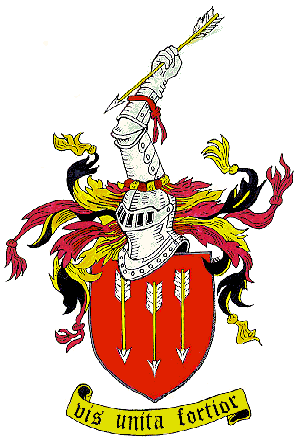
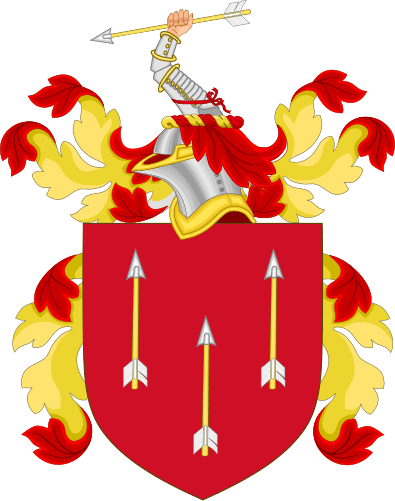
According to the description on the WikiMedia page, this is the Coat of Arms reportedly used by Ensign Robert Hale of Charlestown, Massachusetts, 1630, a direct ancestor of Nathan Hale, based on the heraldic blazon recorded in Matthews’ American Armoury and Blue Book.
Perhaps one day, we might find a family connection to the prominent Colonial Hale family, but for now, we don’t know what that connection is.
 Mightier Acorns

Say hello, cousin!