
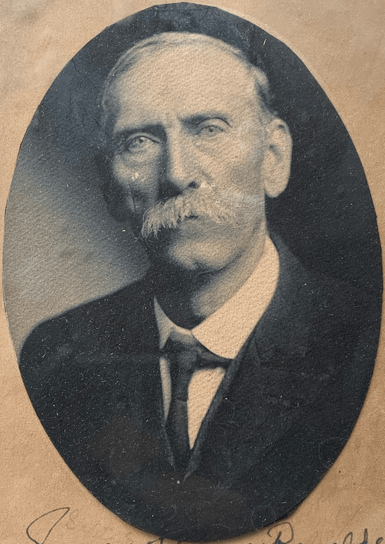
The life and times of James T. Reynolds (1852-1911)
I haven’t talked about the Reynolds family since Family Reunion: Reynolds, and even there, I didn’t say much about my great-great grandfather. One of My Sixteen, James Thomas Reynolds was the son of Reuben Reynolds and Martha Arthur.
Starting out with just state and federal records, I didn’t have much information about Reuben Reynolds. We find the names of “Reuben Reynolds” and “Martha” or “Marthia Arthur” from the death records of their two known sons. When their elder son, James Thomas Reynolds died in 1911, the informant recorded on his death certificate was his oldest son, John Reuben (recorded as Reuben Reynolds). The informant on the 1931 death certificate for their younger son, John Harold Reynolds, was his youngest son, Roy Stanley Reynolds. These two grandsons agreed on Reuben and Martha’s names, but gave different information for their respective places of birth: one said Virginia, the other said Kentucky.
Reuben and Martha were most likely married in 1839, when they were 19 and 20 years old, respectively. Reuben is listed on the 1840 Census as a head of household in Greenup County, Kentucky, and just the two of them appear in the household at that time. They appear again in Greenup County in 1850, still just the two of them. This census gives Reuben’s place of birth as North Carolina and Martha’s as Virginia. All of these records indicate that Reuben was a farmer.
The boys were born after 1850: James in 1852 and John in 1855, and Martha married her second husband, Jeremiah M Shy (1814–1895) on 14 Oct 1858 in Greenup County, Kentucky. There are records for other men called Reuben Reynolds after 1855, and it is possible that Reuben and Martha could have divorced or separated between 1855 and 1858, but the most likely scenario is that Reuben died about 1856.
A Lot of Family in Kentucky
Not long ago, we talked about the Dangerous Time in Kentucky leading up to the Civil War. That story focused on James Madison West, an abolitionist preacher, and his father, Thomas West, who was murdered in Lewis County, Kentucky, in 1862. You might recall that an early suspect in the murder was Thomas’s son-in-law, John Shaw May. He will re-enter this story in a moment.
But first…
James and John Reynolds grew up in the home of their step-father, Jeremiah Shy, along with his children from his first marriage. That home was in Boyd County, Kentucky, near Catlettsburg, in 1860, and in Esculapia, Lewis County, near Tollesboro, in 1870.
I ran into the same trouble finding evidence of James’s marriage that I had with his parents. I know that he did marry, and I know his wife’s name, thanks to the death records of their children, but I have not been able to track down a marriage record. That said, we know he married Mary Frances May, probably in 1875, and that his brother, John Harold, married Catherine Rebecca May on 20 Apr 1876 in Lewis County, Kentucky.
And yes, Mary and Catherine were sisters, the daughters of John Shaw May and Frances Mary West.
There’s a Hole in my Census
For a long time, I didn’t have direct evidence that my great-grandmother, Mary Ann “Vicie” Reynolds, was the daughter of James T and Mary (May) Reynolds. I had unsourced trees passed to me from my grandfather and from different cousins I found on the internet, but I couldn’t find the Reynolds’ 1880 household when and where it was supposed to be. Since Vicie was born in 1879 and married in 1898, the only record likely to place her with her family would be the 1880 Census.
I haven’t found it, yet.
But I did find indirect evidence in the obituary for John Reuben Reynolds:
Retired Minister Dies at St. Albans
Rev. John Reuben Reynolds, 71, a retired Baptist minister, died Sunday at his home in St. Albans. He had been a minister for more than 50 years and was a pioneer in Baptist missionary work. Surviving are his widow, Mrs. Norma Hazel Reynolds; a son, Paul J. Reynolds of Nitro; a daughter, Frances May Reynolds of St. Albans, and a sister, Mrs. Vincie Clark, Middletown, O.
Charleston Daily Mail, Charleston, West Virginia, 7 Apr 1947, Page 2
The only record from 1880 that looks like it might belong to our Reynolds family is for a “James Reyonalds” listed in the household of William and Mary Crawford as a “hired farmhand” in Elk Fork, Lewis County. He’s the right age to be our James Reynolds, but he’s listed as “single” – and he ought to be married with three of his four children. What’s interesting is that the two households below the Crawfords both have the surname “May” – a James May (age 34) and John May (age 56). That is John Shaw May, with his second wife, Mary (St. Clair) Brooks.
That means that if this James Reynolds is our guy, and his wife and kids are living somewhere else (probably in Lewis County), they aren’t living with her parents. For now, I will have to keep looking for other avenues of evidence.
Regardless of the situation in 1880, the youngest of James and Mary Reynolds’s four children, William Smith Reynolds, was born in October 1881, and Mary died on 19 May 1882. After that, James appears to have raised the children on his own, but we don’t see them in the census again until 1900.
So far, I’ve only talked about evidence that paints James as an orphan who found work as a farmhand and suffered the loss of his wife. But after that gap in the records, clues in his later life tell us a different, less lonely story.
Religion: Tool and Problem
While examining the later records to find clues, I noticed that James was identified in the 1900 Census with the occupation “Clergyman” – and further, his son, John Reuben, was, too. The 1910 Census listed his occupation as “Preacher” and his industry as “Intinerant” – which suggests that rather than being the pastor of a specific church, he may have been a circuit rider, a traveling preacher who held services in areas too rural and remote to support a full time church.
James died in 1911, and his death certificate specifies that he was a “Baptist minister” – which raises several questions and gives me some of those other avenues in which to look for evidence. Which kind of Baptist he was might tell me something about his beliefs and his story, and how he fit into post-Reconstrution Kentucky, but I wasn’t sure how to begin looking.
I Googled “Is there a record of Baptist ministers who were ordained in Kentucky in the 1870s?” and the AI answer and several top results told me that, no, there was no single record of members or ministers, unless I knew the local church. Fortunately, further digging led me to “History of Greenup Association 1841 – 1941“, by L. H. Tipton, published on the Baptist History Homepage.
The History was a 36-page pamphlet printed to commemorate the Centennial of the Association, and it turns out that Rev. James Thomas Reynolds and his son were descended from Thomas Reynolds, who was a founding member of the Greenup Association in 1841. The text answers many questions I hadn’t asked yet, and also raises a few. For example, it says that James “began his pastoral work in the Association in 1890 as pastor of Union Baptist Church, Lewis County.” It also points out that his son, J. R. (John Reuben, as we discussed) Reynolds, was a pastor in the Association, and the earliest date given for the J.R.’s ministry was 1898, when he would have been 46 years old.
This history gives me enough details about the lives of James T and John Reuben to be sure we’re talking about the same men. But there are more details, particularly about James’s grandfather and his uncle, Thomas Kelley Reynolds, that I need to unpack, document, and verify.
As exciting as it is to find a source that can tell me something deeper about the people found in the dry Census records and vital statistics, I need to be careful about how I approach these more personal stories. When we go from talking about records, which are more reliable despite the gaps and occasional spelling errors, to talking about stories repeated from pulpits over the course of decades, I have to take into account the biases and motivations of the people who repeated those stories, what they were trying to achieve by telling them, and how they were passed down to the publishers of the Greenup Association’s history.
For now, I’ll just enjoy the fact that I have some solid information to confirm that I’m on the right track and researching the right people.
 Mightier Acorns
Say hello, cousin!