
or “When All of the Acorns Are Mightier”
Sometimes the number of people who existed in our past is too much for us to easily grasp. One way that people in the past tried to grasp that number was to emphasize only the most prominent members of society.
They would choose a subject, and talk about that person, often without saying as much of substance about the person. Sometimes they might allude to the rest of the subject’s family while emphasizing the individual’s relative influence in their local community. Of course, the anonymous authors were usually related to the subjects, and this often resulted in the kinds of biographical sketches we are now accustomed to seeing in old books.
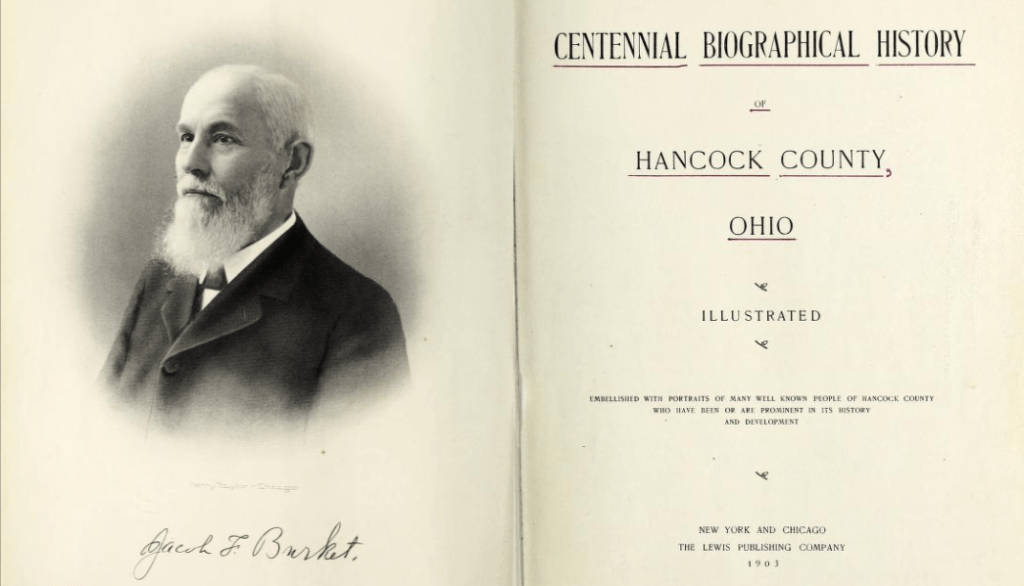
In A Centennial biographical history of Hancock County, Ohio1, we find such a biographical sketch for Baker Dailey, nephew to my 4th-great-grandfather, Baker Hales (1803-1880). I do not mean to suggest that Baker Dailey did not deserve a biographical sketch of his own, but I am perplexed by some of the editorial decisions made by the people assembling this book.
Just look at the florid and expansive way this is written. (I’ve bolded the section that I would consider “the important bit” for my purposes.)
Page 511:
BAKER DAILEY.
A stranger driving through the beautiful county of Hancock cannot help being impressed with the healthfulness of the section, for he will meet with more gray heads to the square mile than in any other section of the state. They are hale and hearty people, some of whom have passed from seven to nine decades in agricultural pursuits in the county. We here present for the consideration of our readers one of this class of citizens, who is a well known farmer of Cass township, and a man of fine repute in the neighborhood. He is a direct descendant of D. J. and Mary Elizabeth (Hale) Dailey. The former of whom was born in Steubenville, Ohio, in 1811, and came with his parents and other members of the family to Hancock county, and located near the center of Washington township in 1825. The latter was a native of Virginia was born in 1815, near Wheeling; she came to this county with her brother Baker, and located in the center of Washington township, where Baker Hale entered one hundred and sixty acres of uncultivated land from the government about 1830. Later in life D. J. Dailey and Mary E. Hale were united in marriage, and made a purchase of their own of eighty acres, which was in time brought under subjection. Mr. Dailey was a hard working man, as indeed all pioneers were in that age, and he labored hard to clear his farm, and to rear his family of ten children, four of whom survive, Baker, Samuel, Alonzo and Margaret. The father and mother were members of the Methodist Episcopal church, and the former affiliated with the Whigs, politically, and in his time was a man of influence in his community, some of the offices…[page 512]…of which he administered. He died February 23, 1890, and his wife June 8, 1883.
From the way the author discusses D.J. Dailey’s political influence, one might think he was the real subject of this sketch!
Throat-clearing and Florid Explication
I can’t complain too much about this particular piece, because in the end, that bolded section gives me some important information about Mary Elizabeth (Hales) Dailey (1815-1883), that isn’t readily available in the pre-1850 Ohio records. I appreciate that the author confirms that Baker Hales and Mary Elizabeth were siblings who came from “near Wheeling” West Virginia.
But look at those first three sentences! Almost none of it is about Baker Dailey, and could be condensed to “Our subject is a farmer of Cass township…” without losing anything of value to the reader.
Whoever wrote this was determined to impress the reader with his ability to inflate bare facts into a tale of bold pioneer life…even though the bare facts are rather plain and ordinary, and the subject was not a “pioneer” in any respect. When he does finally get around to talking about the subject of the sketch, he packs a great deal of information into Baker Dailey’s two paragraphs. Still, if I were the editor, I would have pared down a sentence like:
“Mr. Dailey, while not a politician in any sense of the world, has always manifested a disposition to do his share of the work necessary to carry on a rural community, and has been trusted with some of the offices of the township.”
As a reader, I would prefer a succint: “Mr. Dailey has been entrusted with several township offices.”
I can’t help but wonder if the author didn’t have more information about the family that could have helped me with my research, had he been more focused on communicating the family’s details than on inflating the importance of his subject.
Parsing through indirect language
Even the relevant genealogical information must be carefully teased out of the looping grammatical logic of this text. For example, the author never plainly states that Baker Dailey is the son of D. J. Dailey and Mary Elizabeth Hale. Instead, he breaks up that fact and the reader must look for it in two places within that large paragraph. First, he says, “He is a direct descendant of D. J. and Mary Elizabeth (Hale) Dailey.” Then later, “Mr. Dailey was a hard working man…to rear his family of ten children, four of whom survive, Baker [the subject of the sketch], Samuel, Alonzo and Margaret.”
From this sketch, with minimal use of sentence diagrams, I can flesh out some of the story of my ancestor and his family, and add it to the much more concise sketch of Baker Hales that was published in the History of Hancock County, Ohio2:
“Baker Hales came from Brooke County, Va., in the spring of 1834, and located on the southwest quarter of Section 15, which he entered October 17, 1833. His father, William, came with him, and died at his son’s home. Baker reared a family of six children, two of whom reside in the township, and died upon the home farm. His widow lives in Fostoria.”
pg. 508, Chapter XXVI. Washington TownshipOf course, if I could have a wish granted regarding these sources, I would wish that the author of the first example could spare some of his word budget to augment the details in the second, because I would dearly love to know more about William Hales! But at least with these two secondary sources to point me at Brooke County, Virginia, I have some leads to work with.
- A Centennial biographical history of Hancock County, Ohio, by Lewis publishing company, Chicago, publisher, 1903 ↩︎
- Brown, Robert C; History of Hancock County, Ohio: containing a history of the county, its townships, towns …, Publisher: Warner, Beers & Co. (Chicago, Ill.), 1886. ↩︎


Say hello, cousin!