
posted Friday, October 28, 2016
Note: if you care to revisit the original version of this post from 2016, you will note a few major changes:
I removed the lists of Prof’s descendants for space. His children are linked from his WikiTree profile if you’d like to learn more about them.
I added information about Prof’s third wife, Ella, who I did not learn about until a couple of years after the original post went up.
If you happen to be one of Prof’s Progeny, drop me a note, or leave a comment!
Prof’s Progeny
In our earlier post, 20th Century Callin Clan, we recounted the colorful lives of the children of Civil War veteran John Henry Callin and his wife, Amanda Walker. This week, we will take a look at the descendants of their eldest son:
Byron Herbert “Prof” Callin (1874-1933) was a complex character. Studying his life, and tracing the records he left behind, it is clear that he was driven by ambitions and desires that conflicted with each other. His choices drove him to abandon his family – more than once – and led to his untimely death. There are a lot of questions we won’t be able to answer, and I will try to stick to the facts – but know that there are some parts of this story that are still contentious, and the implications of what we know happened may provoke some strong opinions among his survivors.
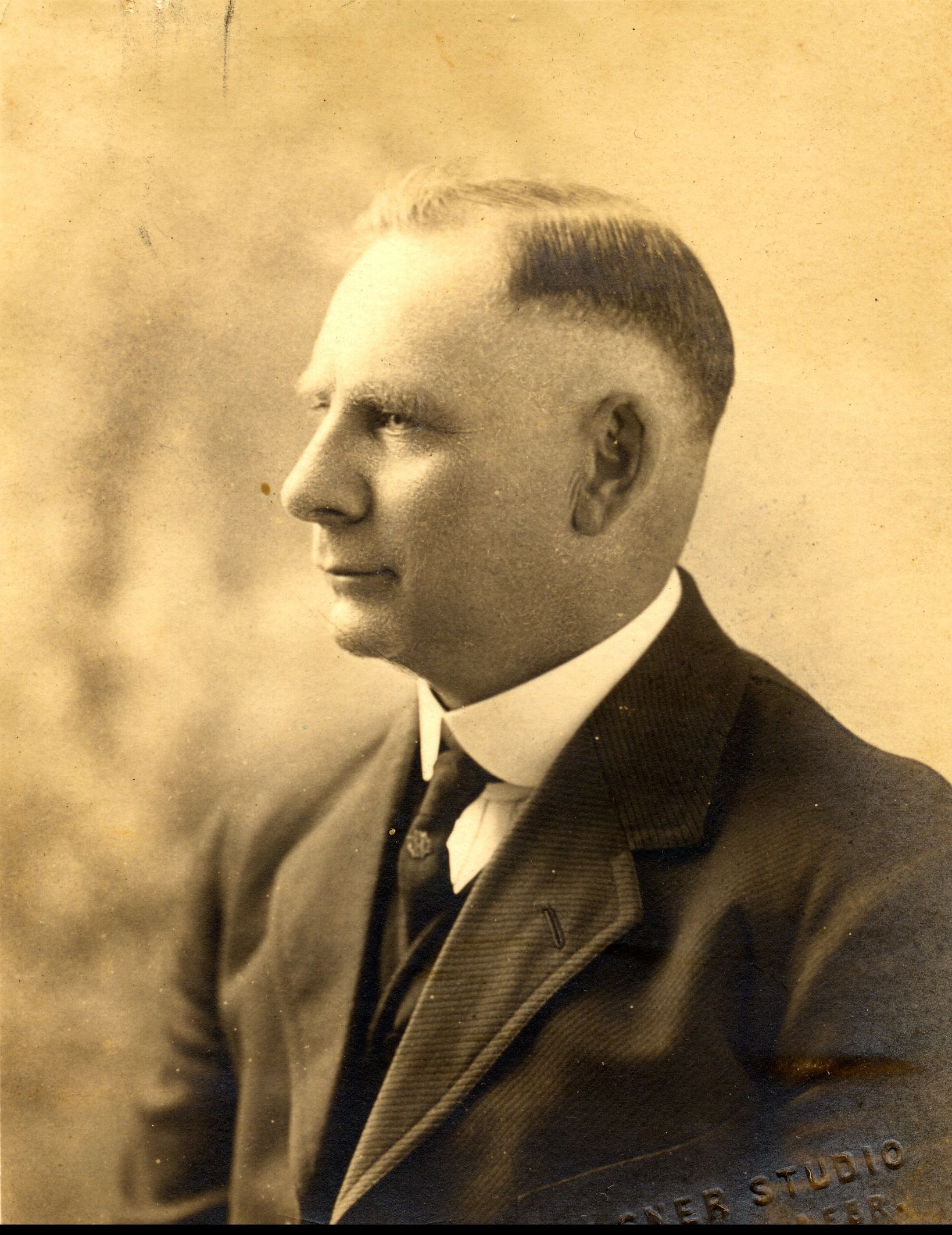
Byron was a precocious student, and a well-known teacher from the time he received his teaching certificate at age 16. His nickname, “Prof,” came from his identity as a teacher, and it seems clear that he inherited his love of learning from his father. Prof seemed to have ideas about how the family name should be pronounced (“Collin,” with the round “ah” sound instead of the flatter “a” of “Callin”), and later in his life, he seems to have preferred to be called “Herbert” instead of Byron, feeling that Herbert was more refined.
He married his first wife, Frances Edith “Fanny” Muir (1873–1946), on 18 July 1896, when he was 21 years old. She was the daughter of one of the Scottish settlers that gave Scotch Ridge its name. John D. Muir (1841–1920) was the son of James Muir and served as a commissioned officer in the Civil War.
Byron and his father-in-law both featured in the local history of Wood County published in the late 1890s, each receiving their own hagiographic sketch. The impression this gives me is that Byron, as the son of one Civil War hero, felt some societal pressure to marry the daughter of another such war hero. The couple’s fathers may have put them together, and the connections between the Callin and Muir families through the United Brethren Church may have also added to that pressure.
Byron and Fannie moved to Dayton, where Byron was teaching in 1900; but not long after that, Byron took a teaching job in South Dakota, and left Fannie in Ohio. They had no children, and it seems to me that either Byron felt the Pull of the West (and Fannie did not), or the couple thought that after some time apart, he would return to her. Regardless of their intentions, Byron was living in Aberdeen, South Dakota in 1905; and by 1910, Fannie Muir was divorced, and living in her father’s home in Webster Township.
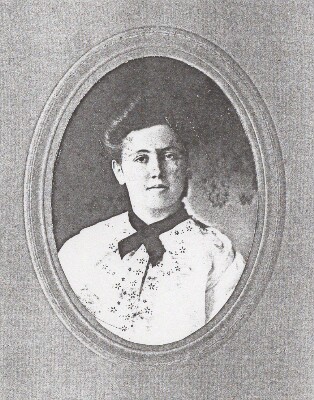
Byron soon remarried. His second wife was Ruby Mary Cole (1885–1973), and it was during their courtship that Byron was injured by his shotgun during a hunting trip. As the story goes, he and Ruby were riding in a buggy, when the horse became spooked. In the subsequent furor, the gun that he had in the front of the buggy discharged and struck him in the right side of his jaw. He carried a terrible scar on his face for the rest of his life – and in the portrait above, you will note that he keeps his right side turned away from the camera. According to Truman Matcham, Byron’s nephew, the family was always suspicious of the story and felt there was more to it than Byron would admit.
Ruby was born in Shabbona, De Kalb County, Illinois, where her parents met. Her father, Elijah Cole, moved the family to South Dakota when she was in her teens. While it isn’t clear how long Byron was in South Dakota before he divorced Fannie, he and Ruby were married in 1906 – and they had three daughters in their household by 1910.
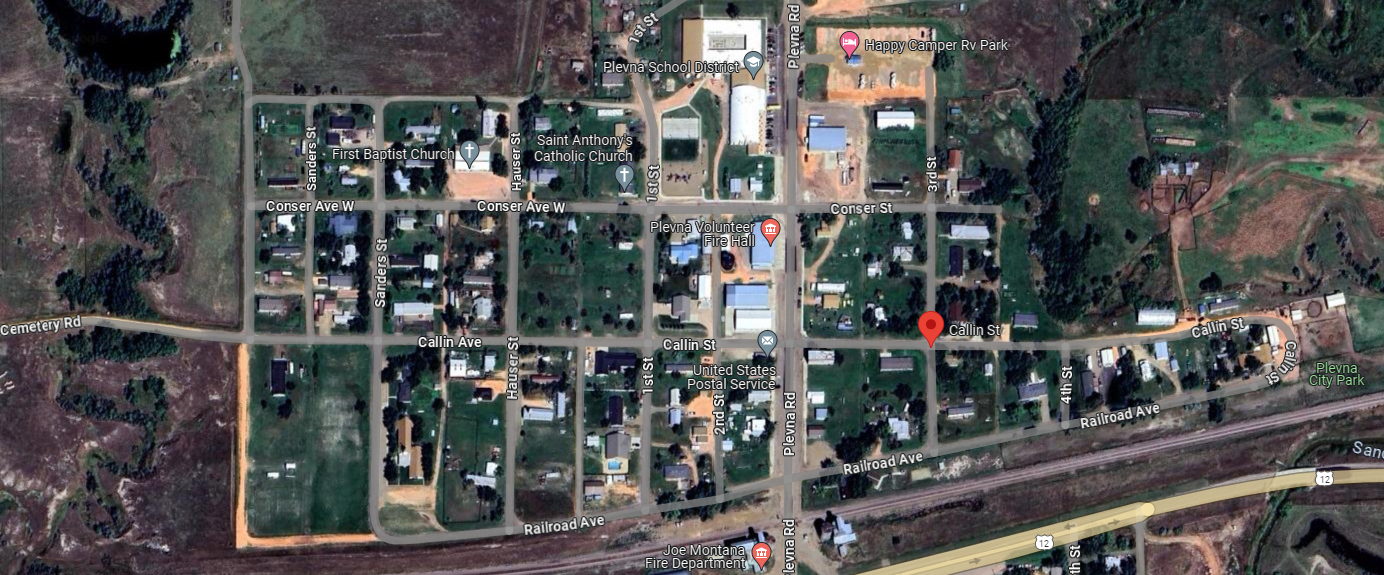
Byron was very much on the move during these years. His children were each born in a different state – Opal in Minnesota, Elda in South Dakota, and Pearl in Montana. Byron was so highly regarded by the town of Plevna, Montana, that they named the main East-West road “Callin St.” (Callin Ave. on the west side). Known then as Herbert Callin, he was the town’s first postmaster and owned the only store “in the midst of the wide prairie.”1
In 1915, the family was settled in Middlefield, Otsego County, New York – known today as the site of Cooperstown – and they remained there for several years. Byron stayed put until 1923, when he moved the family to Reading, Pennsylvania; after that, it isn’t clear where they went, but probably by 1925, Ruby and the children were living back in Ipswich, South Dakota, and Byron stopped appearing in the records.
There is no nice way to say that Prof abandoned his family, but I am told that this is how they felt about it. Around 1930, he divorced Ruby.
Herbert appeared in 1929 in Coudersport, Potter County, Pennsylvania, where he was married to Sarah “Ella” Estright (1887–1931). Ella was the daughter of Samuel James Estright (1858–1956) and Hannah Lucas (1863–1940). She was born in Sep 1887 and grew up in Milesburg, Centre County, Pennsylvania, remaining at home until at least 1920. H.B. Callin and his new wife ran the Ohio Lunch service station and restaurant, which was quite successful. The couple spent their winters in Florida, and in Jul 1930, they sold their business and moved permanently to Panama City, Bay County, Florida, where their daughter, Dot, was born in Jan 1931. Sadly, Ella’s death in Panama City was reported in Coudersport in April 1931.
Left alone to raise a baby girl, Herbert quickly remarried Georgia I Hancock (1910-1996) in 1931. Georgia was the daughter of Robert Daniel Hancock (1874–1952) and Arleta Weaver (1874–1955), born on 17 Sep 1910 and raised in Alford, Jackson County, Florida. Herbert and Georgia had another daughter in Jan 1932, less than a year after Dot was born. Then, not quite two years later, Herbert died on 30 Nov 1933 at age 59 after being shot by his sister-in-law during a family disagreement in Alford.
On 29 November 1933, there was an altercation involving members of the Hancock family and Prof. According to reports in the Palm Beach Post on 30 November:
Alva Hancock, 23, was In the Jackson county jail Wednesday night charged with the slaying of her brother-in-law, H. B. Collins, about 62, in a family quarrel at Alford. “I won’t be here long,” she told officers after calmly reciting details of the killing. Officers quoted her as saying she shot Collins only after he had shot and wounded his wife, who Is Alva’s sister, and had also fired at her father, R. D. Hancock. A charge of buckshot struck Collins, and he died almost instantly, Coroner Douglas H. Oswald reported.
A few months later, in May 1934, the same paper reported that the Grand Jury had not indicted Alva, but she was under investigation for firing a shot at her sister, Georgia. Without other records, it’s hard to say exactly what happened that night. Herbert was buried in Mount Hope Cemetery in Lynn Haven, Bay County, Florida.
Georgia raised her daughters independently until 1942 when she married Abner Mondell Peacock (1889–1973). Georgia and Abner remained together until he died in 1973. Both of her daughters married career military men, one an Air Force technical sergeant, and the other an Air Force colonel. I hope someday to add their children and grandchildren to this history.
PLEVNA MONTANA 75 YEARS, page 68


Say hello, cousin!